| --- |
| title: Deep Audio Classifier Using CNN |
| emoji: 🔉 |
| colorFrom: green |
| colorTo: blue |
| sdk: gradio |
| sdk_version: 6.5.1 |
| app_file: app.py |
| pinned: false |
| license: mit |
| short_description: Audio classification with Mel-spectrogram CNNs. |
| models: |
| - AIOmarRehan/CNN_Audio_Classification_Model_with_Spectrogram |
| datasets: |
| - AIOmarRehan/General_Audio_Dataset |
| - AIOmarRehan/Mel_Spectrogram_Images_for_Audio_Classification |
| --- |
| |
| [If you would like a detailed explanation of this project, please refer to the Medium article below.](https://medium.com/@ai.omar.rehan/building-a-clean-reliable-and-accurate-animal-classifier-using-inceptionv3-175f30fbe6f3) |
|
|
| --- |
|
|
| # Audio-Classification-Raw-Audio-to-Mel-Spectrogram-CNNs |
| Complete end-to-end audio classification pipeline using deep learning. From raw recordings to Mel spectrogram CNNs, includes preprocessing, augmentation, dataset validation, model training, and evaluation, a reproducible blueprint for speech, environmental, or general sound classification tasks. |
|
|
| --- |
|
|
| # Audio Classification Pipeline - From Raw Audio to Mel-Spectrogram CNNs |
|
|
| > *“In machine learning, the model is rarely the problem, the data almost always is.”* |
| > - A reminder I kept repeating to myself while building this project. |
|
|
| This repository contains a complete, professional, end-to-end pipeline for **audio classification using deep learning**, starting from **raw, messy audio recordings** and ending with a fully trained **CNN model** using **Mel spectrograms**. |
|
|
| The workflow includes: |
|
|
| * Raw audio loading |
| * Cleaning & normalization |
| * Silence trimming |
| * Noise reduction |
| * Chunking |
| * Data augmentation |
| * Mel spectrogram generation |
| * Dataset validation |
| * CNN training |
| * Evaluation & metrics |
|
|
| It is a fully reproducible blueprint for real-world audio classification tasks. |
|
|
| --- |
|
|
| # Project Structure |
|
|
| Here is a quick table summarizing the core stages of the pipeline: |
|
|
| | Stage | Description | Output | |
| | ----------------------- | -------------------------------------- | ---------------- | |
| | **1. Raw Audio** | Unprocessed WAV/MP3 files | Audio dataset | |
| | **2. Preprocessing** | Trimming, cleaning, resampling | Cleaned signals | |
| | **3. Augmentation** | Pitch shift, time stretch, noise | Expanded dataset | |
| | **4. Mel Spectrograms** | Converts audio → images | PNG/IMG files | |
| | **5. CNN Training** | Deep model learns spectrogram patterns | `.h5` model | |
| | **6. Evaluation** | Accuracy, F1, Confusion Matrix | Metrics + plots | |
|
|
| --- |
|
|
| # 1. Loading & Inspecting Raw Audio |
|
|
| The dataset is loaded from directory structure: |
|
|
| ```python |
| paths = [(path.parts[-2], path.name, str(path)) |
| for path in Path(extract_to).rglob('*.*') |
| if path.suffix.lower() in audio_extensions] |
| |
| df = pd.DataFrame(paths, columns=['class', 'filename', 'full_path']) |
| df = df.sort_values('class').reset_index(drop=True) |
| ``` |
|
|
| During EDA, I computed: |
|
|
| * Duration |
| * Sample rate |
| * Peak amplitude |
|
|
| And visualized duration distribution: |
|
|
| ```python |
| plt.hist(df['duration'], bins=30, edgecolor='black') |
| plt.xlabel("Duration (seconds)") |
| plt.ylabel("Number of recordings") |
| plt.title("Audio Duration Distribution") |
| plt.show() |
| ``` |
|
|
| --- |
|
|
| # 2. Audio Cleaning & Normalization |
|
|
| Bad samples were removed, silent files filtered, and amplitudes normalized: |
|
|
| ```python |
| peak = np.abs(y).max() |
| if peak > 0: |
| y = y / peak * 0.99 |
| ``` |
|
|
| This ensures consistency and prevents the model from learning from corrupted audio. |
|
|
| --- |
|
|
| # 3. Advanced Preprocessing |
|
|
| Preprocessing included: |
|
|
| * Silence trimming |
| * Noise reduction |
| * Resampling → **16 kHz** |
| * Mono conversion |
| * 5-second chunking |
|
|
| ```python |
| TARGET_DURATION = 5.0 |
| TARGET_SR = 16000 |
| TARGET_LENGTH = int(TARGET_DURATION * TARGET_SR) |
| ``` |
|
|
| Every audio file becomes a clean, consistent chunk ready for feature extraction. |
|
|
| --- |
|
|
| # 4. Audio Augmentation |
|
|
| To improve generalization, I applied augmentations: |
|
|
| ```python |
| augment = Compose([ |
| Shift(min_shift=-0.3, max_shift=0.3, p=0.5), |
| PitchShift(min_semitones=-2, max_semitones=2, p=0.5), |
| TimeStretch(min_rate=0.8, max_rate=1.25, p=0.5), |
| AddGaussianNoise(min_amplitude=0.001, max_amplitude=0.015, p=0.5) |
| ]) |
| ``` |
|
|
| Every augmented file receives a unique name to avoid collisions. |
|
|
| --- |
|
|
| # 5. Mel Spectrogram Generation |
|
|
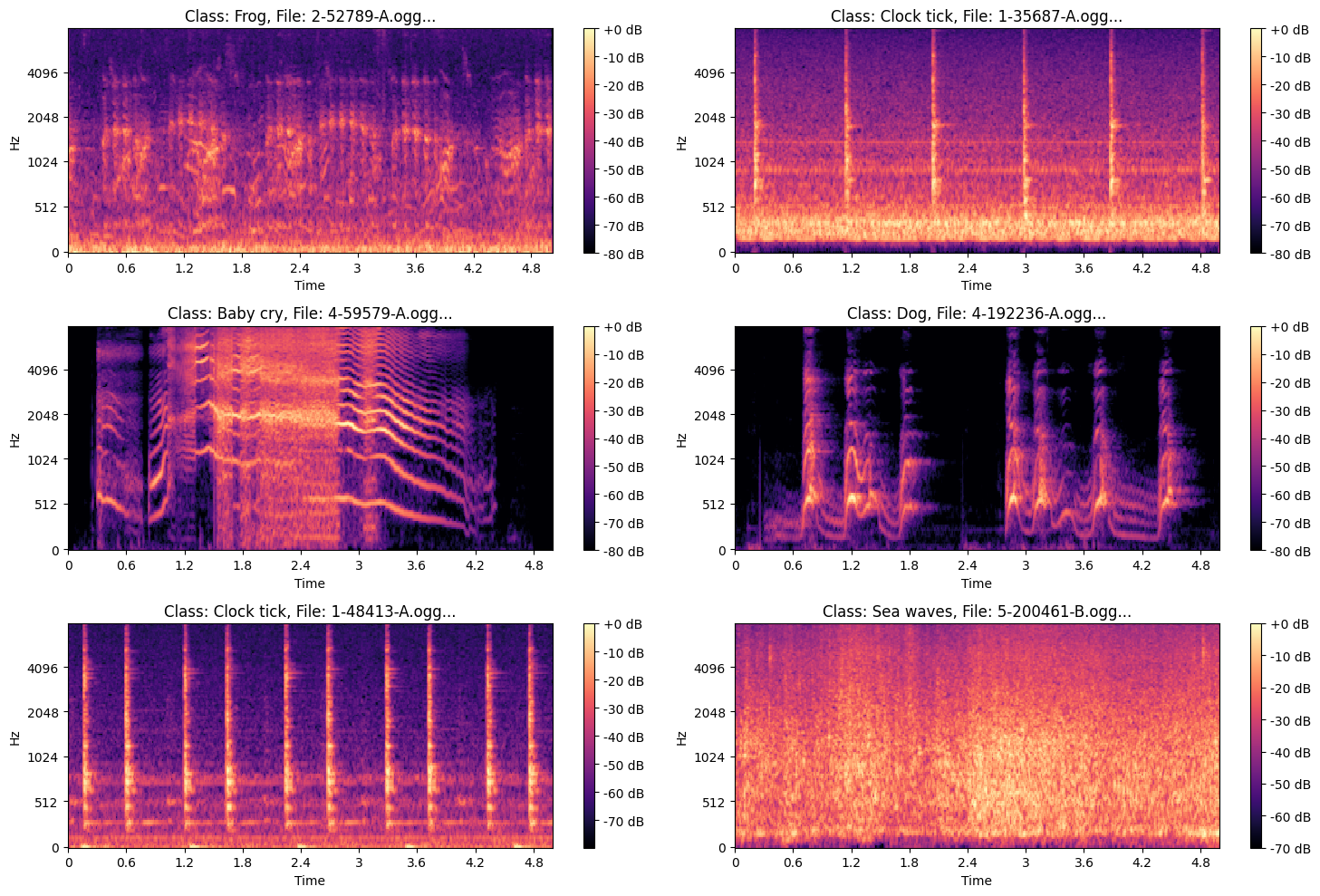
| Each cleaned audio chunk is transformed into a **Mel spectrogram**: |
|
|
| ```python |
| S = librosa.feature.melspectrogram( |
| y=y, sr=SR, |
| n_fft=N_FFT, |
| hop_length=HOP_LENGTH, |
| n_mels=N_MELS |
| ) |
| S_dB = librosa.power_to_db(S, ref=np.max) |
| ``` |
|
|
| * Output: **128×128 PNG images** |
| * Separate directories per class |
| * Supports both original & augmented samples |
|
|
| These images become the CNN input. |
|
|
| ### ***Example of Mel Spectrogram Images*** |
|
|
|  |
|
|
| .png?generation=1763570855911665&alt=media) |
|
|
| --- |
|
|
| # 6. Dataset Validation |
|
|
| After spectrogram creation: |
|
|
| * Corrupted images removed |
| * Duplicate hashes filtered |
| * Filename integrity checked |
| * Class folders validated |
|
|
| ```python |
| df['file_hash'] = df['full_path'].apply(get_hash) |
| duplicate_hashes = df[df.duplicated(subset=['file_hash'], keep=False)] |
| ``` |
|
|
| This step ensures **clean, reliable** training data. |
|
|
| --- |
|
|
| # 7. Building TensorFlow Datasets |
|
|
| The dataset is built with batching, caching, prefetching: |
|
|
| ```python |
| train_ds = tf.data.Dataset.from_tensor_slices((train_paths, train_labels)) |
| train_ds = train_ds.map(load_and_preprocess, num_parallel_calls=AUTOTUNE) |
| train_ds = train_ds.shuffle(1024).batch(batch_size).prefetch(AUTOTUNE) |
| ``` |
|
|
| I used a simple image-level augmentation pipeline: |
|
|
| ```python |
| data_augmentation = tf.keras.Sequential([ |
| tf.keras.layers.InputLayer(input_shape=(231, 232, 4)), |
| tf.keras.layers.RandomFlip("horizontal"), |
| tf.keras.layers.RandomRotation(0.1), |
| tf.keras.layers.RandomZoom(0.1), |
| ]) |
| ``` |
|
|
| --- |
|
|
| # 8. CNN Architecture |
|
|
| The CNN captures deep frequency-time patterns across Mel images. |
|
|
| Key features: |
|
|
| * Multiple Conv2D + BatchNorm blocks |
| * Dropout |
| * L2 regularization |
| * Softmax output |
|
|
| ```python |
| model = Sequential([ |
| data_augmentation, |
| Conv2D(32, (3,3), padding='same', activation='relu', kernel_regularizer=l2(weight_decay)), |
| BatchNormalization(), |
| MaxPooling2D((2,2)), |
| Dropout(0.2), |
| # ... more layers ... |
| Flatten(), |
| Dense(num_classes, activation='softmax') |
| ]) |
| ``` |
|
|
| --- |
|
|
| # 9. Training Strategy |
|
|
| ```python |
| reduce_lr = ReduceLROnPlateau(monitor='val_loss', factor=0.5, patience=10) |
| early_stopping = EarlyStopping(monitor='val_loss', patience=40, restore_best_weights=True) |
| |
| history = model.fit( |
| train_ds, |
| validation_data=val_ds, |
| epochs=50, |
| callbacks=[reduce_lr, early_stopping] |
| ) |
| ``` |
|
|
| The model converges smoothly while avoiding overfitting. |
|
|
| --- |
|
|
| # 10. Evaluation |
|
|
| Performance is evaluated using: |
|
|
| * Accuracy |
| * Precision, recall, F1-score |
| * Confusion matrix |
| * ROC/AUC curves |
|
|
| ```python |
| y_pred = np.argmax(model.predict(test_ds), axis=1) |
| print(classification_report(y_true, y_pred, target_names=le.classes_)) |
| ``` |
|
|
| Confusion matrix: |
|
|
| ```python |
| sns.heatmap(confusion_matrix(y_true, y_pred), annot=True, cmap='Blues') |
| plt.title("Confusion Matrix") |
| plt.show() |
| ``` |
|
|
| --- |
|
|
| # 11. Saving the Model & Dataset |
|
|
| ```python |
| model.save("Audio_Model_Classification.h5") |
| shutil.make_archive("/content/spectrograms", 'zip', "/content/spectrograms") |
| ``` |
|
|
| The entire spectrogram dataset is also zipped for sharing or deployment. |
|
|
| --- |
|
|
| # Final Notes |
|
|
| This project demonstrates: |
|
|
| * How to clean & prepare raw audio at a professional level |
| * Audio augmentation best practices |
| * How Mel spectrograms unlock CNN performance |
| * A full TensorFlow training pipeline |
| * Proper evaluation, reporting, and dataset integrity |
|
|
| If you're working on sound recognition, speech tasks, or environmental audio detection, this pipeline gives you a **complete production-grade foundation**. |
|
|
| --- |
|
|
| # **Results** |
| > **Note:** Click the image below to view the video showcasing the project’s results. |
| <a href="https://files.catbox.moe/suzziy.mp4"> |
| <img src="https://images.unsplash.com/photo-1611162616475-46b635cb6868?q=80&w=1974&auto=format&fit=crop&ixlib=rb-4.1.0&ixid=M3wxMjA3fDB8MHxwaG90by1wYWdlfHx8fGVufDB8fHx8fA%3D%3D" width="400"> |
| </a> |
|
|
| <hr style="border-bottom: 5px solid gray; margin-top: 10px;"> |
|
|
| > **Note:** If the video above is not working, you can access it directly via the link below. |
|
|
| [Watch Demo Video](Results/Spectrogram_CNN_Audio_Classification.mp4) |

