

A ConvNet for the 2020s
Paper • 2201.03545 • Published • 2
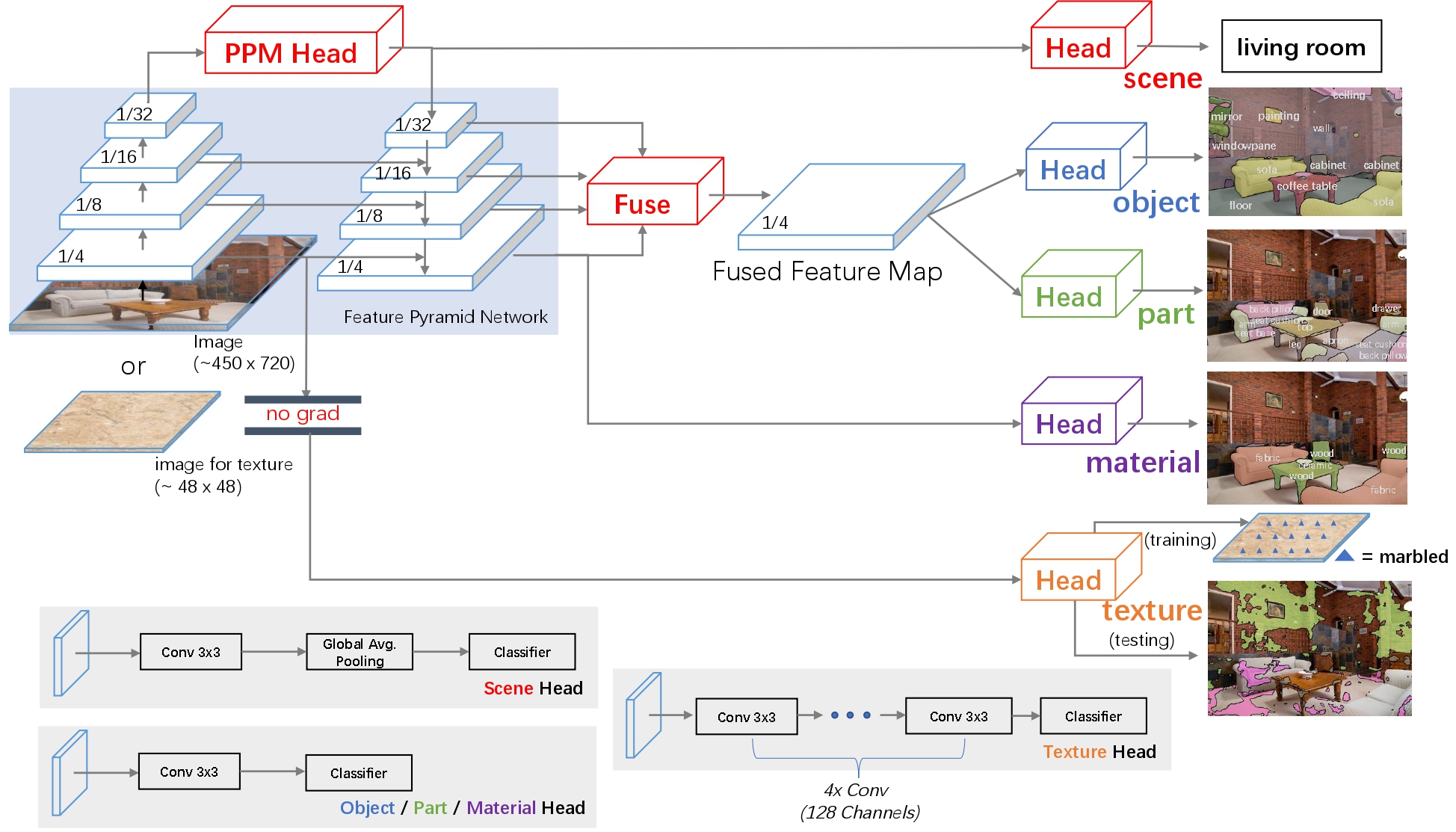
UperNet framework for semantic segmentation, leveraging a ConvNeXt backbone. UperNet was introduced in the paper Unified Perceptual Parsing for Scene Understanding by Xiao et al.
Combining UperNet with a ConvNeXt backbone was introduced in the paper A ConvNet for the 2020s.
Disclaimer: The team releasing UperNet + ConvNeXt did not write a model card for this model so this model card has been written by the Hugging Face team.
UperNet is a framework for semantic segmentation. It consists of several components, including a backbone, a Feature Pyramid Network (FPN) and a Pyramid Pooling Module (PPM).
Any visual backbone can be plugged into the UperNet framework. The framework predicts a semantic label per pixel.
You can use the raw model for semantic segmentation. See the model hub to look for fine-tuned versions (with various backbones) on a task that interests you.
For code examples, we refer to the documentation.